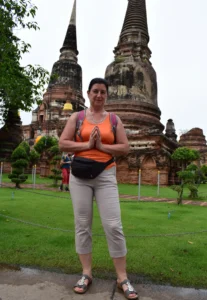
These are the respectful travel tips I come back to on every solo trip, the ones that actually change how a place experiences you as a visitor.
There’s a version of travel that leaves a place a little worse for the presence of the traveler: louder, more entitled, less careful about what it takes to fit into a community that wasn’t built for tourists.
And then there’s the version I love. The kind that arrives curious. The kind that notices what’s around it, asks questions before assuming, watches and learns before charging in. And it’s the kind that goes home understanding something it didn’t before, not just about the place, but about its own assumptions.
Respectful travel isn’t complicated. It doesn’t require extensive ethnographic research or perfect behavior. It requires mostly one thing: genuine curiosity about the people and places you’re visiting, and a willingness to let their customs lead rather than your own comfort.
Here’s what that looks like in practice.
Respectful Travel Tips for Every Solo Trip
Learn the Basics Before You Arrive
You don’t need to become fluent in the culture of every destination you visit. But learning a few basics before you land signals respect and opens doors that casual ignorance keeps closed.
What are the primary religious customs? Are there dress codes at certain sites? Is there a greeting that’s considered respectful, and another that’s considered impolite? Are there specific behaviors that are common in public that would be unusual at home, or vice versa?
A good starting point is a simple search: “cultural etiquette [destination] for tourists” or “things not to do in [destination].” Travel forums and country-specific subreddits often have honest, experienced-traveler takes on what actually matters. The U.S. State Department’s country-specific pages are also worth a look before you go, since most include a “Local Laws & Customs” section alongside the visa information.
This preparation isn’t about memorizing rules. It’s about arriving with some awareness so you can move through a new place without accidentally causing offense or embarrassment. These are the kind of respectful travel tips that take ten minutes to look up and change how the whole trip feels, and they’re worth building into your pre-trip planning checklist long before you pack a bag.
Dress Respectfully (and Practically)
Clothing is one of the most visible signals of respect in many cultures, and one of the clearest everyday examples of cultural etiquette in practice. As a solo female traveler, it’s particularly worth thinking about carefully.
In countries with conservative dress norms, covering your shoulders and knees in public spaces is usually a minimum. In religious sites, mosques, temples, churches, and shrines, additional coverage is often required and sometimes available to borrow at the entrance, but it’s worth having a scarf in your bag as a matter of habit, right alongside the rest of a minimalist, versatile packing list.
This isn’t about erasing your own style. It’s about reading your context. The same pair of linen trousers can be perfectly appropriate in most of Southeast Asia and thoroughly disrespectful at a sacred site in the same region. Pay attention. Adapt.
A practical note: dressing more modestly in unfamiliar public spaces often also reduces the amount of unwanted attention you receive as a solo female traveler. It’s not a requirement, it’s a consideration.
Eat With Curiosity
Food is one of the fastest ways to connect with a culture, and also one of the places where travelers sometimes retreat unnecessarily into the familiar.
Challenge yourself to eat local wherever you can. Visit the market. Try the street food. Sit in the restaurant where the neighborhood residents eat rather than the one that’s been anglicized for tourists. Order the thing you don’t recognize. Ask your host or the restaurant owner what they recommend.
This approach does more than nourish you. It’s one of the simplest forms of responsible travel there is: it puts money into local economies, it creates genuine interaction with people, and it gives you access to a dimension of the destination that the tourist track doesn’t cover.
Table manners vary more than many travelers expect. In some cultures it’s perfectly normal to eat noisily or not finish your plate; in others, the opposite signals respect. In some contexts, passing food with your left hand or pointing with chopsticks carries specific meaning. A small amount of advance research makes these moments feel like learning rather than mistakes.
Engage With Locals With Genuine Interest
One of the greatest gifts of solo travel is how approachable you become to other people. Without a group around you, you’re open in a way that’s unusual and noticeable.
Use that openness well.
When you talk to local people, whether it’s a shopkeeper, a guesthouse owner, someone on a bus or in a cafe, come with genuine curiosity rather than just transactional need. Ask about their day, their work, their thoughts on a local event or tradition. Listen more than you speak. Let the conversation take you somewhere you didn’t expect.
Many of the most memorable moments of solo travel happen in these ordinary interactions. Not at the famous landmark, but in the conversation that started because you asked a question and stayed curious about the answer. It’s one of the cultural travel tips that’s easy to forget and impossible to fake.
Photograph Respectfully
The camera is one of the trickiest aspects of respectful travel.
This is respectful tourism at its most literal: people are not subjects, they’re people. Always ask before photographing someone in a way that makes them a feature of your shot. In many cultures, particularly with elders, religious figures, or people in sacred settings, photographing without permission is genuinely disrespectful. In others, it’s perfectly normal.
When you ask, do so clearly and accept the answer either way. A declined request is not a failed photograph. It’s someone exercising agency over their own image, which is their right.
Religious ceremonies, funerals, private family moments: these are almost universally off-limits without specific invitation. Use judgment and err on the side of restraint.
Handle Cultural Differences in Gender Norms
Respectful travel doesn’t mean tolerating disrespect toward you. As a solo female traveler, you will sometimes encounter expectations and cultural norms around women that differ significantly from your own background.
This is one of the most genuinely complex areas of cultural navigation, and there’s no one-size-fits-all answer. The broad principle: you can respect local customs in public spaces without endorsing them or accepting them as your own values. Covering up in a conservative context is an act of respect for the community you’re visiting, not a statement about your own beliefs.
At the same time, your safety and dignity are not negotiable. If a cultural context makes you feel genuinely unsafe, or if you’re being treated in a way that crosses from cultural difference into personal violation, that’s a different matter entirely. Trust your instincts, remove yourself from situations that feel wrong, and lean on the broader safety habits that apply everywhere you travel solo.
Give More Than You Take
Respectful travel, at its core, is about the balance between what you receive from a destination and what you contribute to it.
Shop from local artisans rather than imported trinket shops. Eat at locally owned restaurants rather than international chains. Use local guides when you take tours. Tip according to local customs, and research those customs in advance.
When you take photographs, buy the postcard from the elderly woman at the entrance rather than just walking past. When someone offers you tea as part of a hospitality tradition, don’t be in too much of a hurry to accept it.
These are some of the simplest respectful travel tips there are, and also some of the easiest to forget in the rush of a trip. These small choices accumulate. They’re the difference between tourism that extracts and tourism that gives something back.
Come Home Changed
The mark of truly respectful travel isn’t just how you behaved in the destination. It’s what you brought home from it.
Did you understand something you didn’t before? Did the visit shift any assumptions? And did you encounter a way of living or a set of values that gave you something to think about?
That’s what travel is for, really. Not just the photographs and the passport stamps, but the quiet internal rearrangement that happens when you’ve genuinely let a place in. In the end, the respectful travel tips above are really just one expression of a bigger practice: paying attention.
The Woman You Meet When You Travel Alone explores this dimension of solo travel too: how to be a traveler who genuinely engages with the world rather than just moving through it, and how that quality of presence shapes not just your experience but the experience of everyone you encounter along the way.