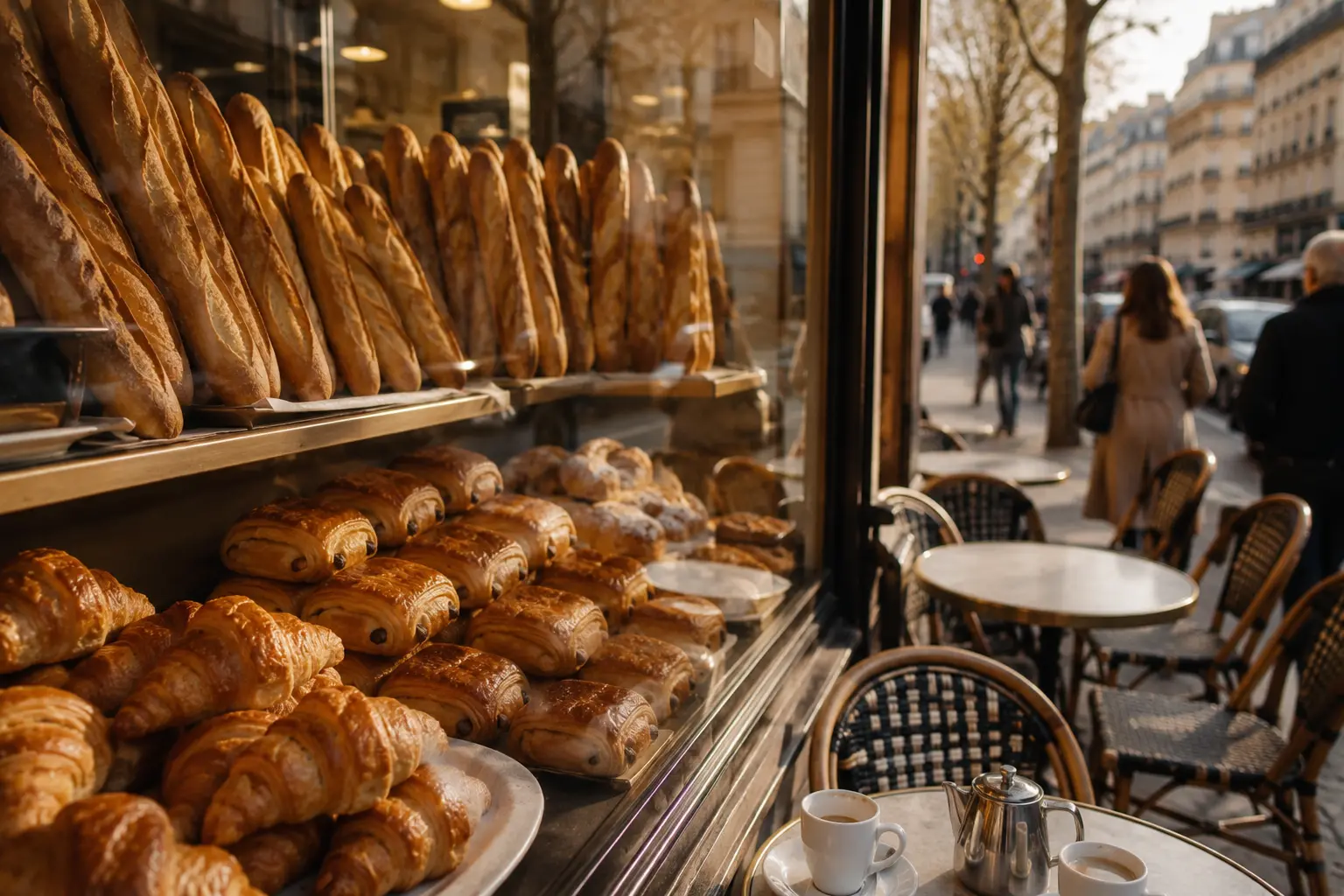
Paris bakeries and cafes are everywhere. Here’s a short, practical rundown of the breakfasts, coffees, and pastries that nearly talked me out of ever dieting again.
It’s nearly impossible to walk around Paris hungry. There’s a bakery, a pastry shop, or a café on almost every corner. If you’re wandering with no destination in mind, you’ll end up in one sooner or later, whether you planned to or not. Here’s what our mornings, coffees, and bakery runs actually looked like.
This post contains an affiliate link. If you book through it, I may earn a small commission at no extra cost to you. It’s one of the ways I keep this blog running. I only recommend things I’d actually use myself.
A Hotel Breakfast That Set the Tone for the Day
Every day started with the hotel breakfast, and it was a pleasant surprise every time. It was a solid buffet spread: fresh pastries, cheeses, cold cuts, fruit, yogurt, and of course, the classic buttery croissant, present without fail.
Some mornings we had two, because it’s impossible to say no. They were crisp on the outside, soft inside, and best when still just barely warm.
The Small Hotel Detail I Didn’t Expect to Love
One little thing became an instant favorite, and we hadn’t seen it at any other hotel before. Near the front desk stood a small table with a chilled glass jar of infused water, set out all day, with mini croissants beside it.
One day it was cucumber, lime, and apple. The next, lemon, orange, and apple. It was always still or sparkling water, with no added sugar. You could pour yourself a glass every time you walked by.
Paris Bakeries and Cafes on Nearly Every Corner
Paris has well over a thousand bakeries, which tells you everything about how central they are to daily life here. We found a new one practically every day. Croissants, baguettes, macarons, and cream-filled pastries lined the windows, almost always at a level of quality that would be a special occasion back home.
We never once left disappointed. For the French, this clearly isn’t a luxury. It’s an everyday habit.
Permission to Actually Enjoy Your Food
I want to pause on that for a second, because it’s easy to read past it. So many of us travel with a quiet guilt attached to food. Don’t eat too much. Skip the pastry. And definitely no second croissant.
Watching a whole culture treat a warm croissant as a normal part of the morning felt like its own kind of permission slip. Not a reward, not a cheat day, just breakfast.
You don’t have to earn a good meal by walking enough steps first. You’re allowed to just enjoy it, the same way a whole city full of people clearly does, every morning, without a second thought.
Boulangerie vs. Pâtisserie: What’s the Difference?
You’ll see both words on shop signs, and they’re not quite the same thing:
- A boulangerie is a bakery focused on bread: baguettes, country loaves, and breakfast pastries like croissants.
- A pâtisserie specializes in finer sweets: tarts, éclairs, macarons, and elaborate cakes.
Many shops do both, so you’ll often see “boulangerie-pâtisserie” on the sign. If you spot the words “artisan boulanger,” it means the bread is made on site, which is a good sign.
What’s Inside a Typical Paris Bakery
A standard Paris bakery isn’t only about sweets. Most also sell savory options, like ham or cheese croissants, quiche slices, and sandwiches on fresh baguette. And of course, the classic baguette itself is sold everywhere, without exception.
Plenty of locals stop at a bakery every day just for a fresh baguette. It’s part of the daily routine here, not a tourist photo op.
Pastries Worth Trying at Least Once
Alongside the classic croissant, don’t skip these:
- Pain au chocolat: the same flaky pastry, filled with chocolate. It quickly became one of our favorites.
- Macarons: sold in almost every pastry shop, in every color and flavor imaginable.
- Éclair: a long choux pastry filled with cream, often coffee or chocolate.
- Tarte aux fruits: a fruit tart that changes with the season.
- Baguette tradition: a slightly more rustic version of the classic baguette, often with a crispier crust.
Paris Cafes on Nearly Every Street
Paris bakeries and cafes really do sit side by side on almost every block. There’s rarely a street without at least one of each.
Many cafés have outdoor seating, and we made good use of it more than once. We’d sit down, order a coffee, and watch the city go by for a while. It was a great way to rest between all the walking, while still soaking up the city instead of hiding from it.
As for coffee, an espresso (simply called “un café”) or a café crème was the most popular choice at nearly every place we tried. Prices vary by neighborhood, but they’re generally reasonable for a major tourist city.
How to Order at Paris Bakeries and Cafes
A little French goes a long way, and the basics are easy:
- Always start with “Bonjour.” Walking in and ordering without a greeting comes across as rude in France. It’s the single most important word to know.
- Ask simply. “Un croissant, s’il vous plaît” (a croissant, please) works perfectly.
- Say thank you and goodbye. “Merci, au revoir” on your way out is the polite norm.
Most staff in central Paris understand basic English too. But opening with “Bonjour” changes the tone of the whole exchange.
Counter or Terrace? What to Know Before You Sit Down
At most cafés, sitting at a terrace table costs more than standing at the counter for the same drink. Cafés often show different prices for the counter (comptoir) and the table (salle or terrasse).
If you just want a quick coffee, drink it standing at the bar like the locals. If you have time to relax, the terrace is worth the extra cost. You’re paying for the seat and the view as much as the coffee.
Fitting Paris Bakeries and Cafes Into Your Day
Between the bakeries and cafes on nearly every block, you’ll never struggle to find something to eat or drink in Paris. A few easy habits help you enjoy them:
- Go in the morning for the freshest croissants and the best selection.
- Grab a pastry for later when you head out sightseeing. It makes a perfect snack between museums.
- Build in café breaks between long walking stretches, instead of pushing through until you’re exhausted.
Want a Local to Show You Around?
If you’d rather have someone show you where the locals actually go, this private food tour of the Saint-Germain district is worth a look. It’s a two-and-a-half-hour walk with a local guide, with tastings at a pastry shop, a chocolatier, a cheese shop, and more. Along the way, it passes the neighborhood’s famous cafés, the Luxembourg Garden, and Saint-Sulpice. Since it’s private, it’s just you (or your small group) and the guide.
A note on the link above: it’s an affiliate link, which means I may earn a small commission if you book through it, at no extra cost to you.
If you’re planning the rest of your days, here’s how we handled getting around in Paris transit, unfiltered, and how we managed Notre-Dame and the Louvre in one day. And if you’re up for a climb to work off a croissant or two, here’s what happened when I took 674 stairs up the Eiffel Tower.
Why These Small Stops Mattered Most
For us, these easy, frequent stops at Paris bakeries and cafes turned out to be one of the best parts of the whole trip. They didn’t take much time, but they gave us permission to slow down. If I’m honest, I needed that a lot more than a good croissant.
Good coffee, a warm croissant, and twenty minutes to watch a city go by: sometimes that’s the whole reason to go. If you’re ready to stop waiting for the “right time” to plan your own trip, The Woman You Meet When You Travel Alone can help you take that first step.