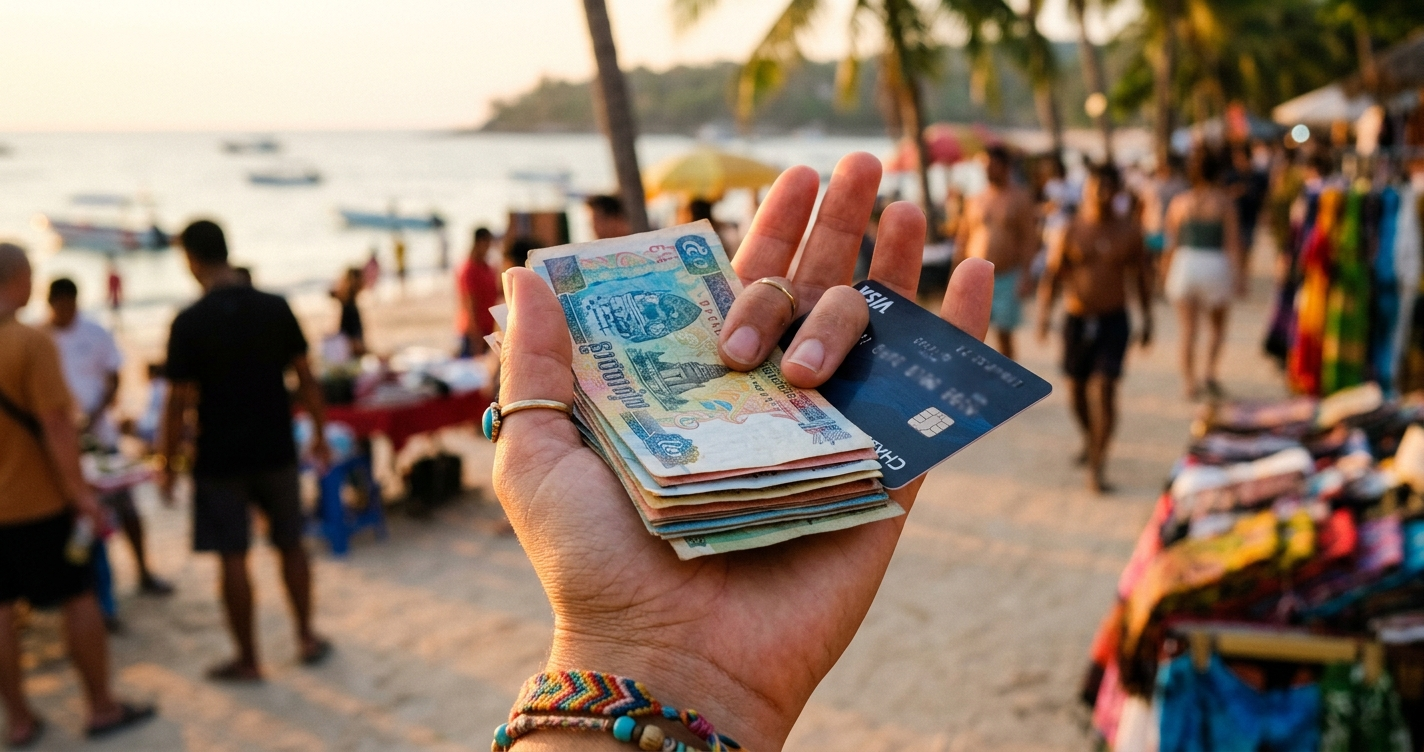
After 26 countries, cash or card abroad isn’t a question I agonize over anymore. I have an actual rule now. It took a lot of taxis, a few local markets, and more than one awkward card-declined moment to get there. Now I know almost instantly which one I’ll reach for, even before I land somewhere new.
This post contains affiliate links. If you sign up through one, I may earn a small commission at no extra cost to you. It’s one of the ways I keep this blog running. I only recommend things I’d actually use myself.
Cash or Card Abroad: Where I Still Need Actual Cash
This is where the cash or card abroad question answers itself. Some things just don’t take a card, no matter how developed a destination feels on paper.
Local markets are the biggest one. Prices aren’t fixed there, and pulling out a card would kill the whole interaction anyway. Smaller, independently run excursions are the same story. Bigger booking-platform tours almost always take a card online, but the local ones often don’t. And taxis are still the most reliably cash-only of the three, even in cities where everything else feels modern.
I felt this most clearly on a mangrove forest canoe tour in Zanzibar, which I booked for the four of us. The taxi that picked us up needed cash on the spot. So did the tour itself, with no card reader in sight for either. Our guide was a local schoolteacher who ran tours on the side. Partway through, he pulled a cooler bag out of the canoe. He sliced up some fruit and passed it around while we drifted.
Why Cash Matters for More Than Just Payments
That’s when the canoe ride turned into something I didn’t expect. He told us he teaches young kids at a local school. Poverty among families in Zanzibar runs deep, and most parents can’t afford basic school supplies. So whatever is left of his salary each month goes on notebooks, pens, and colored pencils for his students. He talked about it so warmly that by the end, all four of us handed him $5 each for the kids.
That’s the other reason the cash vs card abroad question isn’t only about fees for me. I keep cash on me in a country like this one. Card transparency and ATM math matter. But so does handing someone cash in a moment like that, with no app or transfer involved. When you travel somewhere far less wealthy than home, it feels good to give a little back. You can only really do that with cash in hand.
Where a Card Just Works Now
Everywhere else has shifted, and this is the half of the cash or card abroad question that’s changed the most. Hotels, restaurants, and most shops take a card without a second thought these days. Even a handful of years ago, that wasn’t nearly as consistent.
That’s the bigger pattern I’ve noticed across 26 countries. Cash didn’t disappear. The list of places where I actually need it just got a lot shorter and a lot more predictable.
My Cash or Card Abroad Rule of Thumb
I don’t plan cash country by country anymore. On most trips, I bring $300 to $400 in cash as a baseline, wherever I’m going. I treat it as a buffer for markets, small tours, and taxis, not as a full trip budget.
If I run low, I top it up from an ATM. I withdraw bigger amounts less often, the same approach I wrote about after Zanzibar. Pulling small amounts every few days means paying that flat ATM fee again and again: the hidden ATM fees nobody warns you about. Everything else goes on the card by default.
What the Card Actually Needs to Do
Now that paying with cash or card leans so heavily toward the card, what matters most has changed. It’s not which card I have in theory. It’s whether I can see what each transaction costs me, instead of finding out later.
That’s the transparency point I keep coming back to. Wise shows the conversion fee upfront against the real mid-market rate. So I know the cost before I tap the card, not after I read a statement.
It won’t turn a cash-only taxi into a card-friendly one. Nothing will. But it takes the guesswork out of the card side, which is the side doing most of the work these days.
I also broke down what my own card’s foreign transaction fees looked like after a trip to Croatia, with real numbers: how much foreign transaction fees really cost you.
A note on the link above: it’s an affiliate link. I may earn a small commission if you sign up through it, at no extra cost to you.
Cash or Card Abroad: My Honest Answer After 26 Countries
So, cash or card abroad? Mostly card, plus a fixed $300 to $400 cash buffer for the few situations that still need it. Markets, some tours, some taxis. I stopped trying to predict those country by country a while ago, and the pattern has held wherever I’ve gone.
If you want more support turning solo travel from an idea into something that actually feels doable, emotionally and practically, that’s exactly what the book below walks you through.