This Wasn’t How I Planned to Visit the Eiffel Tower
The Eiffel Tower stairs were never part of the plan. When I started booking our visit, I figured it would be the easiest box to check on our entire Paris itinerary. Book a ticket, ride the elevator up, look around, snap some photos, move on to the next thing.
That is not exactly how it went. Honestly, that’s exactly what made it unforgettable.
The Moment I Realized There Were No Elevator Tickets Left
Scrolling through the official booking site (https://www.toureiffel.paris/en), I hit a wall fast. Every elevator time slot was gone. I tried different days, different windows, nothing. The only thing left was the stairs ticket, which gets you up to the second floor on your own two feet.
I sat there for a second, a little stunned. Then I talked myself into it: fine, we’ll walk. I didn’t actually think through what that meant in practice until I read the fine print more closely. That’s when the number hit me.
674 Steps: The Number That Almost Made Me Cancel
The second floor sits at about 377 feet up. That part didn’t sound too bad, since the tower tops out at roughly 1,083 feet, so I wasn’t even climbing halfway. What actually got me was the stair count: 674 steps to the second floor. That’s 327 to reach the first floor, then another 347 to climb from there to the second.
My internal reaction was something like: oh no, that’s it, I’m done for. I could already picture the next morning, barely able to get out of bed, every muscle screaming. 674 steps sounds genuinely intimidating on paper, especially when you’re not exactly training for a marathon, just a regular person hoping for a nice view. [BELSŐ LINK: ha van olyan cikked, ami más túlzottan ijesztőnek tűnő utazási helyzetről szól, ide jól illeszkedne]
Climbing the Eiffel Tower Stairs to the First Floor
Then the day came, and we started climbing. Here’s the first surprise: it was so much easier than I’d built it up to be in my head.
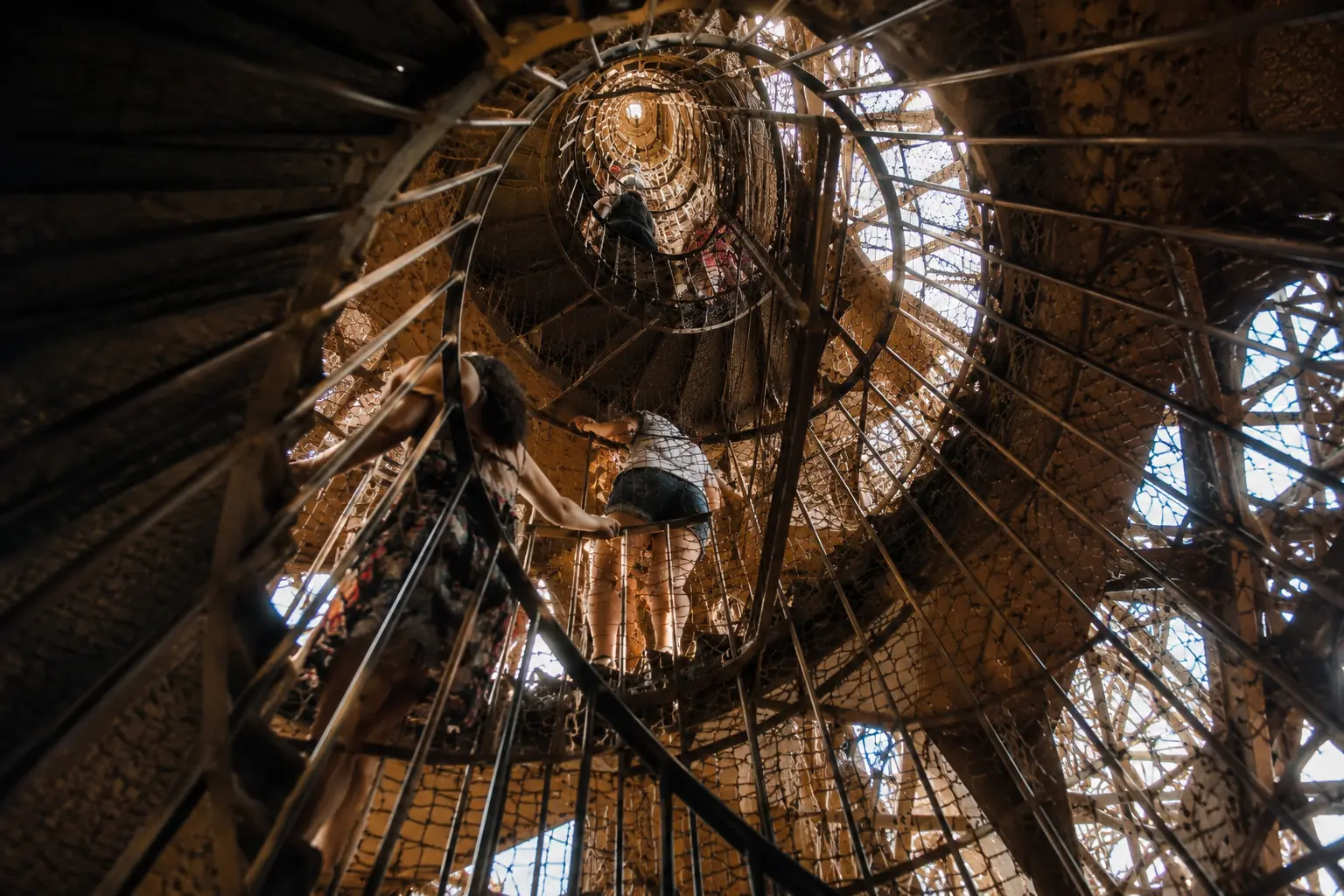
The stairwell itself is its own experience. You’re constantly looking straight at the tower’s ironwork up close, watching the staircase spiral upward between these massive metal beams. That first stretch, up to level one, was honestly just a pleasant walk. Plenty of chances to pause, look around, and start soaking in a view that got more incredible with every step.
Once we reached the first floor, we stopped to walk around, take photos, and catch our breath. That little break did wonders. By that point, the anxiety I’d felt earlier about the step count had basically evaporated. The first floor is worth lingering on its own too. You’re seeing Paris from a completely different angle than street level. There’s a real sense of becoming part of something genuinely iconic, even if just for a few minutes.
Why the Fear Disappeared Halfway Up
Somewhere between the first and second floor, it hit me: the fear I’d felt reading “674 steps” on a screen had absolutely nothing to do with the actual climb. The number was never the real obstacle. My own imagination had built it into something much bigger than it turned out to be.
I think that’s true of almost every big scary number in life, not just staircases. The flight you haven’t booked. The trip you keep pushing to next year. The thing you tell yourself you’re not ready for yet.
You are usually far more capable of handling it than the version of it living in your head. You rarely find that out until you’re already a few steps in.
The Second Stretch: Ironwork Up Close
After catching our breath, we tackled the second stretch, from level one up to level two. Somehow this part went even faster. Maybe we’d found our rhythm. Maybe the view and the structure around us just distracted us too much to notice the steps ticking by.
As we climbed, I found myself really studying the ironwork surrounding us: the beams, the bolts, the rivets, practically inches from our faces. It’s easy to forget, looking at a photo or a postcard, just how many individual pieces had to come together to build something like this in the late 1800s. All of it entirely by hand, precise enough to still be standing more than a century later.
The tower itself has an interesting footnote worth knowing. Builders only meant it to stand for twenty years before tearing it down, and plenty of Parisians at the time thought it was an eyesore. The only reason it survived is that the antennas on top turned out to be excellent for radio signals. That made it too useful to demolish.
What I Learned Climbing the Eiffel Tower Stairs
If you end up in the same position I was in, no elevator ticket, stairs or nothing, here’s what I want you to know: don’t let the number scare you off. The Eiffel Tower stairs sound intimidating on paper. But with two natural rest stops built in, it’s a completely doable, honestly enjoyable walk. You don’t need to be in great shape. You just need a little patience and the willingness to actually enjoy the climb, instead of only chasing the view at the top.
If we’d taken the elevator, we’d have been up and down in a few minutes. Quick photos, then gone. Because we didn’t have that option, we got to slow down, actually look at the tower from the inside, and turn the whole thing into something far more personal. If I ever make it back to Paris, I think I’d choose the stairs again, just to feel that same moment one more time. The one where you realize the things you’re most afraid of usually turn out to be a lot more manageable than they looked from the ground.
Every trip has its own version of “674 steps,” the thing that looks impossible until you’re actually standing in the middle of it. If you’re still waiting for the fear to go away before you book your own first trip, The Woman You Meet When You Travel Alone meets you exactly at that moment.